
trusted by clients since 1993
Pregnancy Massage Safety Guide NZ: When It’s Safe, When to Wait, and What to Check First
Pregnancy Massage Safety Guide NZ: When It’s Safe, When to Wait, and What to Check First
Pregnancy massage can be a safe and supportive treatment when it is adapted properly for your stage of pregnancy, symptoms, comfort, and health history. The key is not simply having a massage while pregnant. The key is having treatment that is screened, modified, and designed specifically for pregnancy.
During pregnancy, your body changes quickly. Posture shifts, joints and ligaments feel different, circulation changes, sleep is often affected, and muscles in the lower back, hips, neck, shoulders, and legs can work harder than usual. A good pregnancy massage is designed around those changes. It should never feel like a standard massage with the word “pregnancy” added on.
This guide explains what makes pregnancy massage safer, when caution is needed, when medical advice should come first, and what a professional therapist should assess before treatment begins. If you are specifically trying to decide whether to go ahead with treatment, see when to avoid pregnancy massage.
Is Pregnancy Massage Safe?
For many women, yes. Pregnancy massage is often appropriate when the pregnancy is progressing normally and the therapist uses pregnancy-safe screening, positioning, pressure, and clinical judgement. Safety comes from how the treatment is planned and adapted, not from vague claims or one-size-fits-all rules.
A safe pregnancy massage session usually includes:
- A short health review before treatment
- Questions about your trimester, symptoms, and recent changes
- Comfortable supported positioning
- Pressure adjusted to the area being treated and to your comfort
- Willingness to postpone treatment if symptoms suggest medical review is needed first
Massage should support comfort and function. It should not override warning signs, replace medical care, or continue when the picture is unclear.
What Pregnancy Massage May Help With
When treatment is appropriate, pregnancy massage may help reduce muscular tension, ease postural strain, improve physical comfort, and give your nervous system a chance to settle.
Common reasons women book include:
- Lower back tightness
- Hip and glute discomfort
- Neck and shoulder tension
- Heavy or tired legs
- Sleep-disrupting muscular discomfort
- General physical fatigue
That said, not every ache in pregnancy should be assumed to be muscular. Some symptoms need checking before bodywork. Our article on warning signs before pregnancy massage explains what to watch for.
What Makes A Pregnancy Massage Session Safer?
Safety is built through screening, technique choice, positioning, communication, and clinical restraint. A therapist should ask about your due date, current symptoms, relevant medical advice, medications, history of complications, swelling patterns, headaches, blood pressure concerns, and whether anything has changed recently.
Even if you have had massage before pregnancy, the session should not be treated as routine. Pregnancy changes the context. That means the therapist should be thinking about comfort, circulation, tissue sensitivity, symptom patterns, and whether any signs suggest treatment should be modified or delayed.
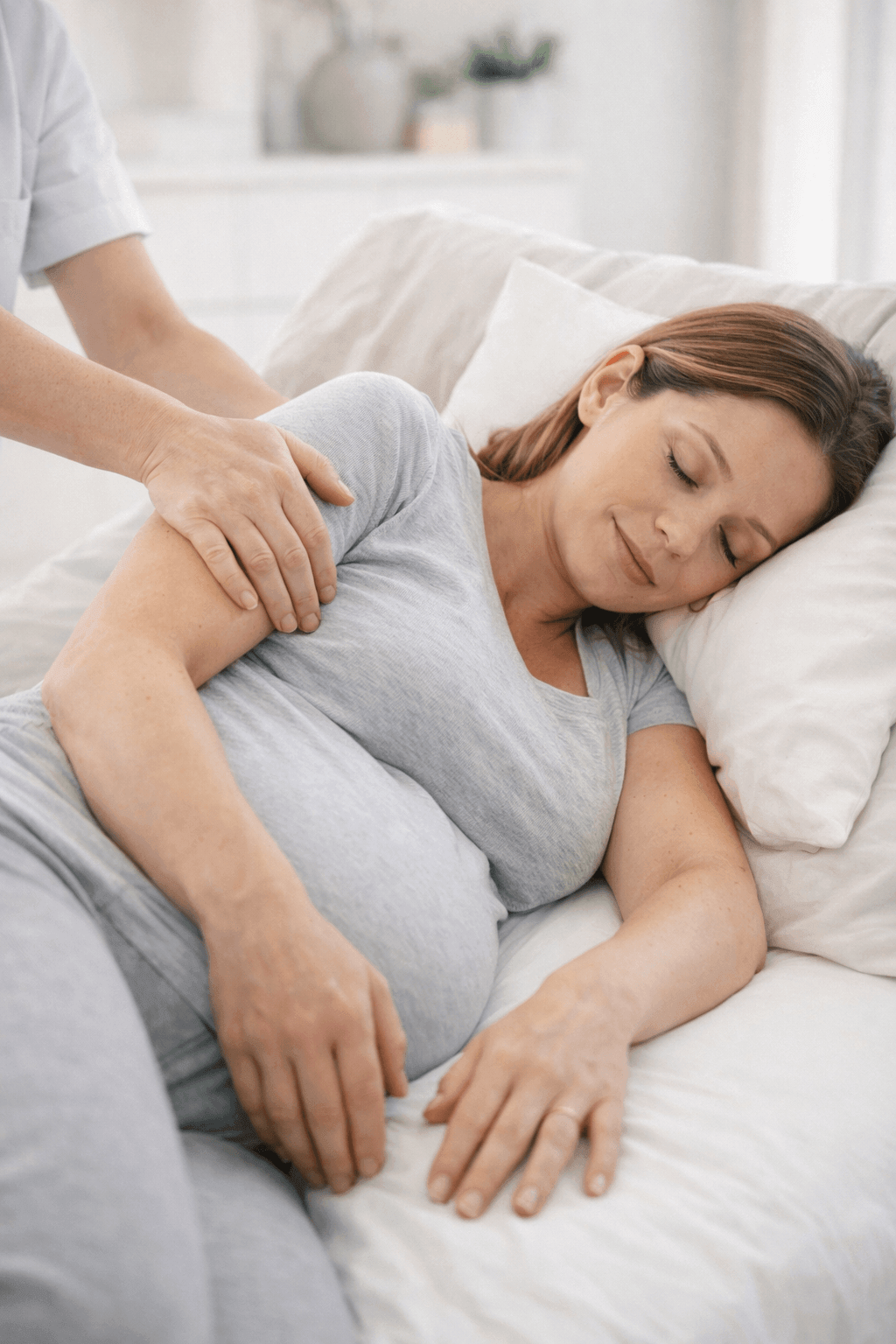
Positioning matters as well. As pregnancy progresses, lying flat for long periods is often not the most comfortable or practical option. Supported side-lying treatment is commonly preferred because it reduces pressure, improves comfort, and gives better access to common tension areas. Learn more in pregnancy massage positioning and pressure.
Why Screening Matters Before Treatment
A proper screening process is a safety feature, not an inconvenience. You should expect questions about how many weeks pregnant you are, whether anything has changed since your last check-up, whether you have headaches, dizziness, unusual swelling, calf pain, bleeding, fluid loss, or any concern that has already been raised by your midwife, GP, or specialist.
You should also expect questions about comfort. Which positions feel good? Which ones do not? Are there areas that feel overly sensitive? Are there symptoms that become worse with pressure or movement? A therapist who screens carefully is not trying to create fear. They are trying to keep the treatment appropriate.
When Caution is Needed Before Booking
Pregnancy massage is not automatically unsuitable just because something feels complicated, but some situations do require more care. Extra caution may be appropriate if:
- Your pregnancy has been classified as high risk
- You have been told to limit activity or monitor symptoms closely
- You are experiencing new or unusual swelling
- You have headaches with visual changes
- You have calf pain, redness, or heat
- You feel feverish or acutely unwell
- You have vaginal bleeding, fluid loss, or significant abdominal pain
- Your midwife, GP, or obstetric team has advised caution
In those cases, the safest next step may be review first, massage second. This does not always mean massage is completely off the table. Often it means timing, clearance, or modifications matter.
High-Risk Pregnancy and Massage
One of the most common misunderstandings around prenatal massage is the idea that high-risk pregnancy always means no massage at all. In reality, high-risk pregnancy is a broad category. Sometimes massage is inappropriate at that time. Sometimes it may be suitable only with medical approval. Sometimes it is possible, but only in a reduced and highly modified form.
The detail matters. A therapist should never guess. If there is uncertainty, collaboration with your midwife, GP, or specialist is the more responsible choice. For a focused explanation, read pregnancy massage and high-risk pregnancy.
First Trimester Questions
The first trimester often brings a different kind of discomfort. Fatigue, nausea, breast tenderness, headaches, and sensitivity to touch can all change what treatment should feel like. Some women feel excellent with gentle treatment early on. Others do better waiting until symptoms settle or energy improves.
There is no single rule that all first trimester massage is unsafe. A more useful question is whether treatment is appropriate for the individual person on that day. Pressure may need to be lighter, the session may need to be shorter, and positions may need to change more often. For a deeper look, see first trimester pregnancy massage safety.
Swelling, Circulation, and Red Flags
Mild swelling in the feet and ankles can be common in pregnancy, especially later in the day or in warmer conditions. But not all swelling is equal. One-sided swelling, calf pain, marked redness, unusual heat, sudden facial swelling, or swelling that comes with headache or visual changes should not be brushed off as ordinary pregnancy discomfort.
Massage may help when the issue is ordinary fluid retention and muscular heaviness, but it should be delayed when symptoms raise concern for something that needs medical assessment. Read more in pregnancy swelling and when to seek medical advice.
When Medical Clearance May be Needed
Not every pregnant client needs formal medical clearance before massage. But there are times when it is sensible. If symptoms are unusual, the pregnancy is being monitored more closely, or the therapist cannot confidently assume treatment is appropriate without further input, clearance may be the safest step.
In New Zealand, that might come from your midwife, GP, obstetrician, or specialist, depending on who is managing the issue. The purpose is not paperwork for the sake of it. The purpose is clarity. Learn more in medical clearance before pregnancy massage in NZ.
What a Safe Pregnancy Massage Should Feel Like
A safe pregnancy massage should feel calm, supported, and responsive. It should not feel aggressive, rushed, or difficult to tolerate. You should be able to change position, ask for less pressure, or stop a technique without feeling awkward.
Good treatment usually feels like the therapist is paying attention to both the tissue and the person. That means noticing breathing, body language, sensitivity, fatigue, and how symptoms respond during the session.
- Pressure should be easy to adjust
- Positioning should feel stable and comfortable
- Sensitive areas should be approached carefully
- The treatment should stay within your tolerance
- The plan should change if you feel unwell or uncomfortable
When to Wait and Get Advice First
You should consider pausing and checking with your lead maternity carer, GP, or specialist first if you have any symptom that feels unusual, severe, rapidly worsening, or different from your normal pattern. The same applies if you already know your pregnancy needs close monitoring.
Massage is supportive care. It is not a substitute for clinical assessment. If the situation is unclear, it is better to wait than to push ahead.
Choosing a Provider for Pregnancy Massage
Look for a clinic that treats pregnancy massage as a specific service rather than an add-on. Good signs include pregnancy-aware screening, clear guidance around contraindications, adaptive positioning, and a calm explanation of what the session will involve.
Clinical precision matters here. You want a provider who can distinguish between ordinary muscular discomfort and symptoms that require a more cautious approach, without sounding alarmist or dismissive.
Frequently Asked Questions
Can I have pregnancy massage in any trimester?
Often yes, but the session should be adapted to your trimester, symptoms, and medical context.
Does swelling always mean I should cancel?
No. Mild general swelling can be common, but sudden, severe, painful, or one-sided swelling should be checked before massage.
Is side-lying the best position?
For many women, yes. It is usually more comfortable and practical than standard treatment positions.
Do I need a Doctor’s note?
Not always. It is more relevant when symptoms are unusual, the pregnancy is high risk, or your care team has already raised concerns.
Can massage replace medical care for pregnancy pain?
No. It can support comfort, but it should not replace medical assessment when symptoms suggest something more serious.
What if I feel unwell on the day of treatment?
It is better to postpone and check what is going on first than to push through a session you are unsure about.
Conclusion
Pregnancy massage can be a valuable form of support when it is handled properly. The safest approach is not based on hype, fear, or blanket rules. It is based on screening, communication, symptom awareness, sensible positioning, and knowing when to proceed and when to pause.
If you want the booking-focused version of this topic, including when treatment may need to be delayed, see when to avoid pregnancy massage and whether you should wait before booking.
Further Reading
- When to avoid pregnancy massage
- Pregnancy massage and high-risk pregnancy
- Symptoms that should be checked before prenatal massage
- Massage safety in the first trimester
- When pregnancy swelling needs medical advice first
- How safe positioning and pressure should feel
- When to get clearance before booking pregnancy massage
Safe, soothing touch for you and your little one
Tags :
Refine - Body
Post Related
Unveil Your Most Beautiful Self.
Refine
Body
Face

Services
Follow us on :
Copyright © 2025 Interactive Therapies (2025) Ltd | Powered by Business Squad